Product Description
Integrating barcode systems with ERP platforms is a game-changer for operational efficiency, especially in environments like yours where precision and traceability are paramount. Here is a structured breakdown tailored to your industrial and analytical mindset:
Why Integrate Barcode with ERP?
- Real-time data capture: Scanned data instantly updates inventory, production, or dispatch modules.
- Error reduction: Eliminates manual entry mistakes in stock counts, order processing, and labeling.
- Improved traceability: Tracks items from receipt to dispatch, crucial for quality control and audits.
- Faster workflows: Speeds up receiving, picking, and shipping processes.
- Regulatory compliance: Ensures accurate documentation for industries with strict labeling standards.
Integration Methods
|
ERP System
|
Integration Approach
|
|
SAP ECC / S/4HANA
|
Use SAP Console, ITS Mobile, or middleware like SAP Business Connector
|
|
Microsoft Dynamics 365
|
Leverage PowerApps or custom APIs for mobile barcode workflows
|
|
Oracle NetSuite
|
Built-in WMS barcode tools; RF-SMART for advanced workflows
|
|
Custom ERP
|
Use middleware or develop RESTful APIs for scanner-to-ERP communication
|
Key Components
- Barcode hardware: Choose between 1D/2D scanners, rugged handhelds, or mobile computers.
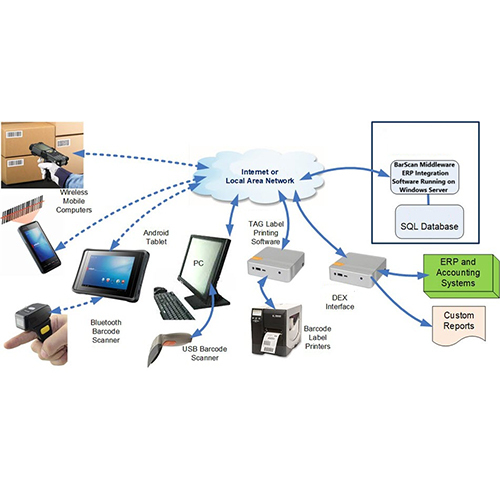
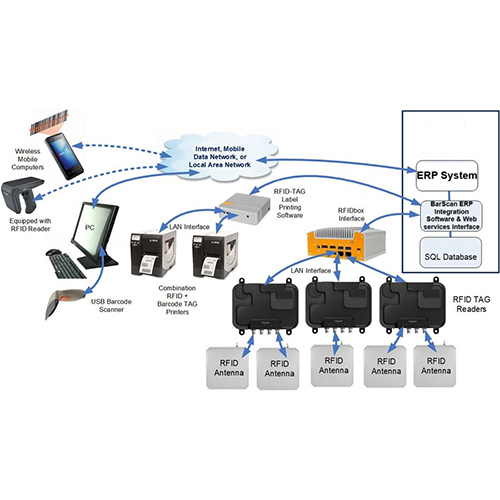
- Middleware/API: Acts as a bridge between scanner input and ERP database fields.
- Data mapping: Align scanned fields (SKU, batch, serial) with ERP modules like inventory or production.
- Label design software: Tools like BarTender or NiceLabel or our customized label designing printing software for generating ERP-compatible barcode labels.
Implementation Steps
- Assess ERP capabilities: Confirm barcode support or plugin availability.
- Select compatible hardware: Ensure scanner firmware and connectivity (USB, Bluetooth, Wi-Fi) match ERP specs.
- Map workflows: Define touchpointsgoods receipt, WIP tracking, dispatch, etc.
- Test integration: Simulate real-world scenarios to validate data flow and error handling.
- Train users: Ensure operators understand scanning protocols and ERP interactions.
Advanced Security and AccessibilityEnsure your data is always protected with robust security measures, including role-based access controls and encrypted data transfers. The system accommodates both local and remote teams by providing deployment on-premise or via the cloud, accessible through Windows, Linux, and web-based platforms. This guarantees your operations are safe, scalable, and available whenever needed.
Flexible Integration and CustomizationEasily connect to a variety of ERP platforms such as SAP, Oracle, Microsoft Dynamics, and Tally using API-based, middleware, or custom connectors. The solution supports multi-location setups and is optimized for high-volume transactions. Customizable dashboards and multilingual support create a user-friendly experience for diverse teams.
Comprehensive Reporting and ComplianceStay ahead with automated barcode activity and integration log reports. This integration ensures compliance with GS1 and ISO standards, as well as industry-specific requirements. Real-time validation and error logging maintain data accuracy and support swift troubleshooting, while regular updates and 24x7 support keep your system running smoothly.





 Send Inquiry


